Monday, 2 August 2027
Total solar eclipse of 2 August 2027
The longest total solar eclipse over easily accessible land this century. See on the map where day turns into night, when the eclipse starts in your city and how much of the Sun the Moon will cover.
Time left-
- Longest totality
- 6 min 23 s, near Luxor (Egypt)
- Path of totality
- Spain, Gibraltar, Morocco, Algeria, Tunisia, Libya, Egypt, Saudi Arabia, Yemen, Somalia
- Partial eclipse visible
- across almost all of Europe, North Africa and the Middle East
What will the eclipse look like where you are?
Eclipse map
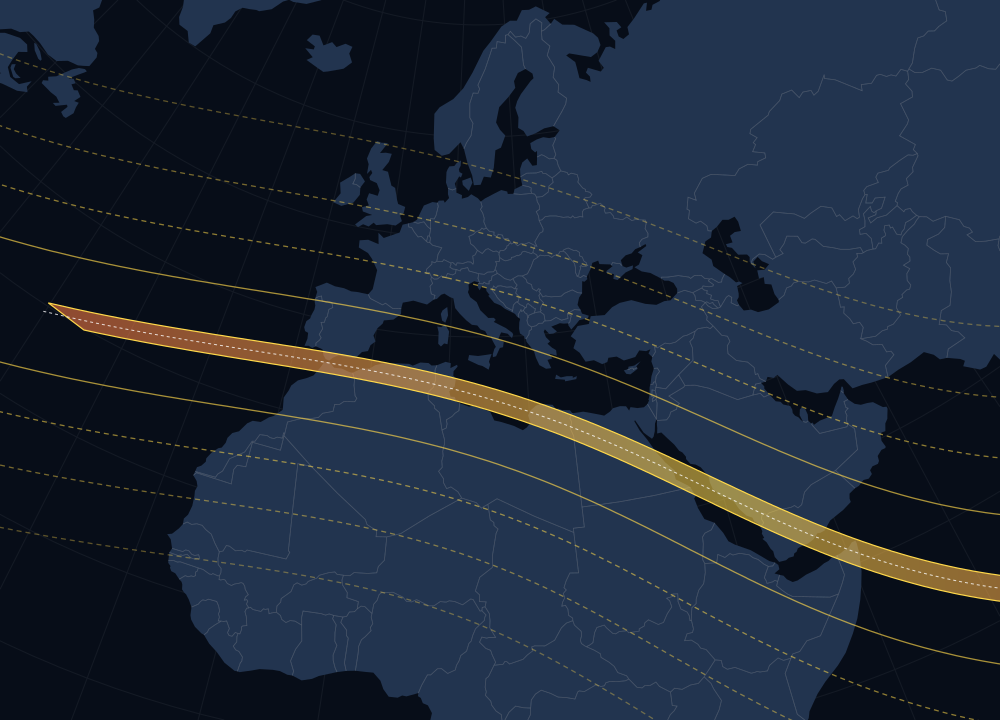
The yellow band is where the eclipse is total. The lines show how much of the Sun disappears behind the Moon.
Where to see the total eclipse
Cities in the path of totality, longest totality first. The time is when darkness starts, in local time.
| Place | Dark from | How long | Sun |
|---|---|---|---|
| SohagEgypt | 12:58:43 | 6 min 22 s | 81° |
| LuxorEgypt | 13:02:02 | 6 min 20 s | 82° |
| QenaEgypt | 13:01:31 | 6 min 11 s | 81° |
| BenghaziLibya | 11:27:47 | 6 min 9 s | 68° |
| AsyutEgypt | 12:56:50 | 6 min 7 s | 81° |
| AbhaSaudi Arabia | 13:34:11 | 6 min 3 s | 71° |
| JeddahSaudi Arabia | 13:22:19 | 5 min 59 s | 76° |
| SfaxTunisia | 10:08:44 | 5 min 39 s | 56° |
| Marsa AlamEgypt | 13:07:59 | 5 min 30 s | 81° |
| OranAlgeria | 09:51:01 | 5 min 8 s | 43° |
| MeccaSaudi Arabia | 13:24:09 | 5 min 8 s | 75° |
| TétouanMorocco | 08:45:07 | 4 min 51 s | 38° |
| TangierMorocco | 08:44:37 | 4 min 50 s | 38° |
| CeutaSpain | 10:45:17 | 4 min 48 s | 38° |
| TarifaSpain | 10:45:04 | 4 min 38 s | 38° |
| MelillaSpain | 10:48:10 | 4 min 33 s | 41° |
| GibraltarGibraltar | 10:45:30 | 4 min 27 s | 38° |
| AlgecirasSpain | 10:45:23 | 4 min 26 s | 38° |
| Al HoceimaMorocco | 08:46:57 | 4 min 25 s | 40° |
| DjerbaTunisia | 10:09:50 | 4 min 24 s | 57° |
| La Línea de la ConcepciónSpain | 10:45:33 | 4 min 23 s | 38° |
| Los BarriosSpain | 10:45:25 | 4 min 20 s | 38° |
| San RoqueSpain | 10:45:34 | 4 min 17 s | 38° |
| BarbateSpain | 10:44:57 | 4 min 16 s | 38° |
| NadorMorocco | 08:48:18 | 4 min 14 s | 41° |
| ChefchaouenMorocco | 08:45:25 | 4 min 13 s | 39° |
| Conil de la FronteraSpain | 10:44:56 | 4 min 0 s | 38° |
| TaifSaudi Arabia | 13:26:00 | 3 min 53 s | 75° |
| EsteponaSpain | 10:46:15 | 3 min 37 s | 39° |
| Chiclana de la FronteraSpain | 10:45:11 | 3 min 29 s | 38° |
| San Pedro de AlcántaraSpain | 10:46:35 | 3 min 23 s | 39° |
| MarbellaSpain | 10:46:45 | 3 min 17 s | 39° |
| San FernandoSpain | 10:45:17 | 3 min 12 s | 38° |
| FuengirolaSpain | 10:47:08 | 3 min 10 s | 39° |
| TlemcenAlgeria | 09:50:55 | 3 min 10 s | 43° |
| Puerto RealSpain | 10:45:27 | 2 min 55 s | 38° |
| CádizSpain | 10:45:21 | 2 min 54 s | 37° |
| BenalmádenaSpain | 10:47:22 | 2 min 51 s | 39° |
| MijasSpain | 10:47:18 | 2 min 51 s | 39° |
| TorremolinosSpain | 10:47:32 | 2 min 42 s | 39° |
| Alhaurín el GrandeSpain | 10:47:25 | 2 min 30 s | 39° |
| El Puerto de Santa MaríaSpain | 10:45:39 | 2 min 28 s | 37° |
| Alhaurín de la TorreSpain | 10:47:39 | 2 min 22 s | 39° |
| CoínSpain | 10:47:25 | 2 min 21 s | 39° |
| RotaSpain | 10:45:40 | 2 min 10 s | 37° |
| Rincón de la VictoriaSpain | 10:48:13 | 1 min 55 s | 39° |
| CártamaSpain | 10:47:48 | 1 min 54 s | 39° |
| AlmuñécarSpain | 10:48:58 | 1 min 51 s | 40° |
| MálagaSpain | 10:48:06 | 1 min 51 s | 39° |
| AdraSpain | 10:49:50 | 1 min 46 s | 41° |
| Torre del MarSpain | 10:48:35 | 1 min 41 s | 40° |
| MotrilSpain | 10:49:16 | 1 min 40 s | 40° |
| Jerez de la FronteraSpain | 10:46:13 | 1 min 37 s | 38° |
| NerjaSpain | 10:48:53 | 1 min 35 s | 40° |
| Roquetas de MarSpain | 10:50:27 | 1 min 34 s | 41° |
| El EjidoSpain | 10:50:17 | 1 min 23 s | 41° |
| RondaSpain | 10:47:30 | 1 min 18 s | 39° |
| Vélez-MálagaSpain | 10:48:53 | 1 min 3 s | 40° |
| Arcos de la FronteraSpain | 10:47:05 | 0 min 40 s | 38° |
Partial eclipse in other cities
How much of the Sun the Moon covers at maximum.
United Kingdom2
Egypt10
Morocco9
Spain46
Gibraltar1
Malta1
Portugal1
Greece1
Türkiye1
Switzerland1
United Arab Emirates1
France1
Germany3
Hungary1
Austria1
Belgium1
Czechia1
Poland14
Netherlands1
Ireland1
India1
Kenya1
Denmark1
Latvia1
Norway3
Sweden1
Thailand1
Estonia1
Finland1
Iceland1
How to watch the eclipse safely
- Only look at the Sun through eclipse glasses that meet the ISO 12312-2 standard. Ordinary sunglasses do not protect your eyes.
- Cameras, binoculars and telescopes need a solar filter on the front of the lens. Never look through them while wearing eclipse glasses, the focused light burns through.
- You can look without protection only during totality, when the Moon hides the whole Sun. As soon as the first bright point of the Sun returns, put your glasses back on.
FAQ
Is the eclipse visible in the UK?
Yes, as a partial eclipse. The Moon covers between 27% of the Sun (Edinburgh) and 42% (London). The maximum is at about 10:00 BST. The nearest total eclipse is in southern Spain.
When is the 2027 solar eclipse?
On Monday 2 August 2027. The Moon's shadow touches Earth over the Atlantic at about 8:26 UTC, reaches Spain around 8:45 UTC, Egypt around 10:00 UTC and leaves Earth over the Indian Ocean at about 11:50 UTC.
Where is the 2027 total solar eclipse visible?
The path of totality is about 250 km wide. It crosses the southern tip of Spain (Cádiz, Málaga, Tarifa), Gibraltar, northern Morocco, Algeria, Tunisia, Libya, Egypt (Luxor, Asyut), Saudi Arabia (Jeddah, Mecca), Yemen and Somalia.
How long does totality last?
Up to 6 min 23 s near Luxor in Egypt. In Spain up to almost 5 minutes, for example 2 min 54 s in Cádiz and 4 min 48 s in Ceuta. It is the longest total eclipse over easily accessible land in the 21st century, a longer one only comes in 2114.
Can I look at the eclipse with the naked eye?
No. Even when 90% of the Sun is covered, the rest can damage your eyes. You need eclipse glasses meeting ISO 12312-2. Only inside the path of totality, during full darkness, can you take them off for a moment.
Calculated by Zenitmap from F. Espenak's Besselian elements (EclipseWise.com, NASA). Times may differ from other sources by a few seconds.